
No Greater Revolution
How the ministry of Christ, which began in a backwater of the all-powerful Roman Empire, helped catalyze the cognitive mental leap from H. sapiens to H. divergens.

Every civilization can be read as a progression in human consciousness. Over time, moral boundaries consolidate, empathy evolves, and the concept of humanity is rewritten. Within that centuries long evolution, a singular event was also the greatest leap forward: the ministry of Christ. My analysis of that event is not theological in the confessional sense but cognitive and historical. The way I see it, the teachings and example of Christ catalyzed a transition in human cognition and moral awareness that helped a new type of human, Homo divergens, emerge more prominently from the dominant Homo sapiens milieu.
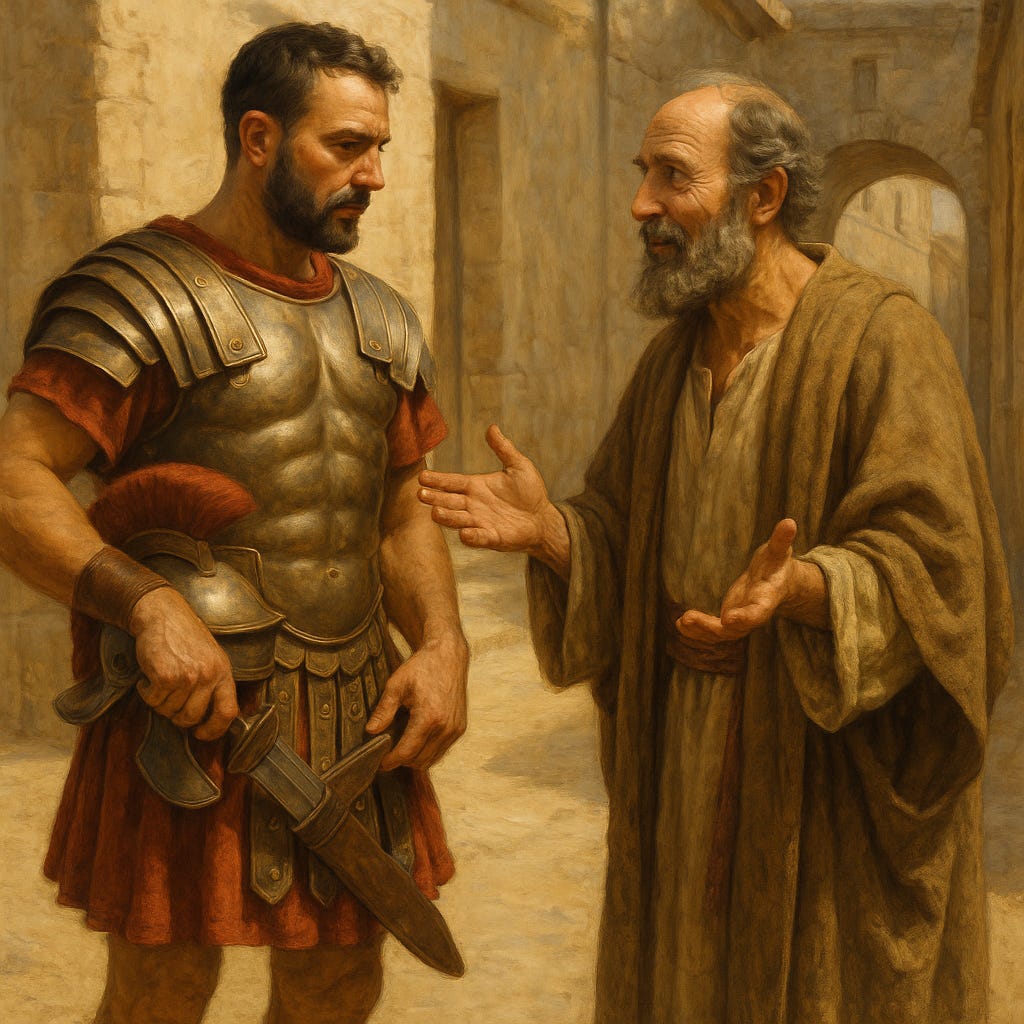
Homo sapiens can be understood here as the adaptive species that built tribes, laws, hierarchies, and empires, which were necessary frameworks for survival but limited by fear, conformity, and group dominance. Homo divergens, by contrast, represents a cognitive variant inclined toward introspection, abstract empathy, and moral self-regulation. This is not a biological mutation but a psychological and spiritual differentiation: an evolutionary turn within the same human stock.
The ministry of Christ, which began in a backwater of the all-powerful Roman Empire, helped crystallize that cognitive mental leap. Through his teaching, actions, and the self-awareness he modeled, Jesus introduced ways of thinking and feeling that disrupted the Roman H. sapiens order and suggested a higher moral order, one that promoted conscience over custom and compassion over tribal loyalty.
Before Christ: The Cognitive and Moral Horizon of the Axial Age
Long before Christ appeared in Galilee, in certain corners of human society moral imagination was being stretched. Between roughly 800 and 100 BCE, the period that Karl Jaspers (1953), the German-Swiss psychiatrist and philosopher and one of the most important figures in German existentialism, called the Axial Age, thinkers from Greece to India to Israel questioned inherited hierarchies and sought transcendence within the self. Socrates and Plato turned philosophy inward, teaching that truth was accessible through reasoned reflection. The Buddha urged detachment from craving and compassion for all sentient beings. The Hebrew prophets denounced empty ritual and demanded justice and mercy.
It is my belief that these parallel awakenings mark the first public appearances of Homo divergens. Humanity was beginning to experience morality as internal rather than imposed. In ancient Israel, this took the form of a covenant not merely with another tribal deity but with a moral God whose concern was justice and fidelity. Yet, in reading the old Testament, it is obvious to many scholars that the tension between ritual obedience and moral conscience remained unresolved. The Jewish religious establishment enforced purity codes and sacrificial rites, while prophets like Amos, Isaiah, and Micah called for empathy, humility, and care for the poor. Judaism thus stood at the threshold of divergence: a people entrusted with universal moral law yet struggling within the H. sapiens framework of tribal identity and order. Into that setting stepped a teacher whose message inverted its logic.
Jesus as Cognitive and Moral Innovator
The ministry of Jesus of Nazareth introduced to humanity a more radical interiorization of moral life. When he said, “The kingdom of God is within you” (Luke 17:20-21), he redefined divine authority as something internal rather than external. This was not the voice of ritual but of consciousness itself. In that sentence lies the essence of divergence: the awakening of the inner locus of moral control.
Christ’s teachings, masterfully publicized by his greatest apologist, Paul of Tarsus, sought to dissolve boundaries that had long divided Homo sapiens societies. Jew and Gentile, Roman and barbarian, slave and free, male and female, were now joining in their common human heritage. His parables consistently forced listeners to inhabit another’s perspective: the Samaritan, the leper, the prodigal son. Each story trained the mind in cognitive empathy, the ability to simulate another’s experience. In modern neurocognitive terms, these parables activated the brain’s mirror neuron systems, rehearsing compassion as a mental act (Iacoboni, 2009).
His ethic inverted the dominance hierarchy of sapiens civilization. “The last shall be first” (Matthew 20:16), “Blessed are the meek” (Matthew 5:5), “Love your enemies” (Matthew 5:43-48). These pronouncements had the potential to undermine the survival logic of power and status that had governed human behavior for millennia. To forgive one’s enemy was to short-circuit the limbic reflex of retaliation. It required a cortical override—an act of reflective self-control mediated by empathy networks in the anterior cingulate and medial prefrontal cortex (Decety & Jackson, 2004). The Sanhedrin and the Governor of the Roman Province, Pontius Pilate, grasped the essence of this revolutionary idea. It couldn’t be allowed to proceed.
Equally transformative was Christ’s insistence on intention over ritual. “You have heard it said… but I say to you,” a formula Jesus uses in the Sermon on the Mount, punctuates the shift from external compliance to interior motive and marks a profound cognitive advance: morality as an act of insight rather than obedience. The Sermon on the Mount thus reads like the moral code of Homo divergens: introspective, non-tribal, empathic, and self-transcending. That it was then poorly applied says nothing about its validity, as much as about humanity’s long and ongoing journey of self-discovery.
The Early Church as a Divergent Subculture
After Christ’s death, his followers formed communities that attempted to embody this new consciousness. They shared possessions, cared for the poor, and proclaimed equality before God. These were not political acts but cognitive ones: they instantiated an alternative model of human relationship grounded in empathy and conscience rather than coercion. The early Christian community represented a behavioral phenotype of Homo divergens.
Paul of Tarsus gave this ethic a philosophical and universal expression in his letter to the community of Christians at Galatea, in the highlands of central Anatolia, which is modern-day Turkey. His declaration that “there is neither Jew nor Greek, slave nor free” (Galatians 3:28) abolished the tribal identity structure of Homo sapiens. Paul reiterates that righteousness comes through faith rather than law. In cognitive terms, Paul articulated a fully abstract moral system, detached from ethnic or ritual anchors, dependent only on conscious identification with the mind of Christ.
As Christianity spread, it was inevitable that it would clash with H. sapiens institutions. The egalitarian impulse of the early communities was gradually absorbed into hierarchical structures, liturgies, and dogmas. The move to Rome was crucial in consolidating the absorption. The Roman, later Catholic, Church preserved the divergent message but clothed it again in the garments of authority. Still, the seed had been sown: the idea that moral law could reside within individual conscience rather than in priest or emperor.
The Christic Mind and Neurocognitive Integration
From a neuropsychological perspective, Christ’s consciousness represents an unusual integration of cognitive systems. Iain McGilchrist (2019) describes the divided brain as two modes of attending to the world: the left hemisphere, analytical and controlling, and the right, holistic and empathic. Most of human history has favored the left’s mastery and categorization. Christ’s teachings and demeanor suggest a rebalancing, with the reassertion of right-hemispheric attention to the living whole. His actions exemplify an awareness that perceives persons, not categories; situations, not rules.
Such integration allows for what can be called metacognitive empathy: the ability to perceive another’s interior state while maintaining self-reflection (Guamanga, et al., 2025). Neuroscientific studies associate this with co-activation of the default mode and salience networks, yielding both perspective-taking and moral discernment (Lamm, Decety, & Singer, 2011). In that light, Jesus Christ’s parables and miracles were not only supernatural interruptions of nature but perhaps primarily pedagogical devices for reshaping cognition toward that integrated awareness.
The parabolic method, teaching through story and symbol, promotes neural participation rather than passive reception. Each listener reconstructs meaning through imagination, activating neural pathways associated with empathy and insight. In this sense, Christ’s pedagogy trained the brain toward divergence: it sparked inner simulation, not rote acceptance.
From External Authority to Inner Locus
At the psychological level, the shift Christ inaugurated was from heteronomy to autonomy. The H. sapiens world operated under external authority: the law, the high priest, the patriarch, the governor, the emperor. The Christic world invited moral reasoning from within. “Let your ‘Yes’ be yes and your ‘No’ be no” (Matthew 5:37). In my definition, this clarity of conscience, independent of external enforcement, is a signature trait of Homo divergens.
Modern developmental psychology offers parallels. Lawrence Kohlberg’s stages of moral reasoning (1981, 1984) identify the transition from conventional to post-conventional morality as the movement from social conformity to principled self-authorship. Christ’s ethic anticipates that post-conventional stage by two millennia: “The Sabbath was made for man, not man for the Sabbath” (Mark 2:27).
This interior moral compass also redefined humanity’s experience of God, not as a Being localized in a temple but encountered every day and everywhere within human awareness. To “love God and neighbor” (Mark 12:30-31) became indistinguishable acts, collapsing the dualism between the sacred and the human. The “Love God – Love People” bumper sticker of an Atlanta church reflects that thought. Cognitively, this revolutionary fusion produced a higher-order integration of emotional empathy and abstract theology: the divine as relational consciousness rather than external sovereignty.
The Legacy of Divergent Ethic
In the following centuries, the divergent impulse seeded by Christ continued to flourish. It appeared in monastic hospitality, in the abolition of slavery, in movements for human rights and social reform. Historically, these manifestations often clashed with H. sapiens systems. The Spanish Inquisition, the Crusades, the tormented history of the Papacy, and authoritarian dogmas illustrate the reassertion of hierarchy against divergence. Yet even within those structures, figures like Francis of Assisi, Teresa of Ávila, and Martin Luther King Jr. re-embodied the Christic archetype: compassion transcending boundary, conscience defying conformity.
To this day, just open your browser and see the tension between the two human types continuing to persist. Homo sapiens builds institutions, while Homo divergens seeks to change their spirit. The first seeks social order, the second social meaning. Without H. sapiens stability, divergence disintegrates; without H. divergens, institutions ossify. Christ’s ministry revealed how both can, and must, coexist within a single humanity, one rooted in survival, the other in transcendence.
Christ as Catalyst of Cognitive Evolution
As I try to describe Christ’s role in evolutionary terms, I wouldn’t refer to him as an external miracle worker but as an internal evolutionary catalyst. What is a catalyst? In chemistry, a catalyst is something that speeds up a process without being changed by it. Jesus was definitely an original. His unchanging nature modeled the next stage of human cognition: integrative empathy, universal identification, and self-reflective agency. He did not help “create” Homo divergens from nothing; he crystallized what had been gestating in prophetic, philosophical, and mystical traditions throughout the then-known world.
Insightful theologians have labeled this catalytic function as incarnation: the divine mind, the Logos, entering Earth’s history in human form to speed up its moral and cognitive growth. In this view, Christ’s life is not only salvific but developmental. In a decisive moment, uniquely revolutionary, humanity awakened to new capacities.
For two thousand years now, Christianity has struggled to stay awake. The institutions that bear Christ’s name often reflect the power structures he subverted. Yet the divergent consciousness he embodied continues to appear in secular humanism, restorative justice, and global empathy movements. His message has outgrown its original religious frame, and now shapes, albeit imperfectly, political ideals and humanitarian ethics alike.
The question remains whether humanity as a whole will complete the transition. In an age of artificial intelligence, digital tribalism, and clash of cultures, the need for a deeper understanding of Christ’s message has never been greater. His mode of being remains the prototype: a person who integrates intellect and compassion, reason and grace.
The Archetype and Its Future
I see Christ’s contribution to the emergence of Homo divergens in three dimensions. Historically, he appeared at a point of maximal cultural readiness, when humanity was capable of self-reflection but not yet liberated from external law. No one could have anticipated it. The religious-political system of the age failed to see it as anything but a threat to the established order. Psychologically, he demonstrated a unified consciousness that fused empathy and agency. Spiritually, he revealed the possibility of inner divinity, the moral law written in our heart.
In Jesus, the evolution of moral cognition reached a point of inflection. The figure of Christ stands not only at the center of theology but at the crossroads of anthropology. Whether one views him as the Son of God or the exemplar of awakened humanity, the outcome is the same: he disclosed what humanity could become when empathy triumphs over dominance and conscience transcends conformity. The work of Homo divergens continues. Each age must rediscover what he revealed: moral life begins not in the law but in love, not in the tribe but in the Self, a self who is capable of seeing the other as kin.